- AI Weekly Wrap-Up
- Posts
- New Post 1/14/2025
New Post 1/14/2025

Keith Collins MD
January 14, 2026
Top Story
OpenAI makes a major move into healthcare
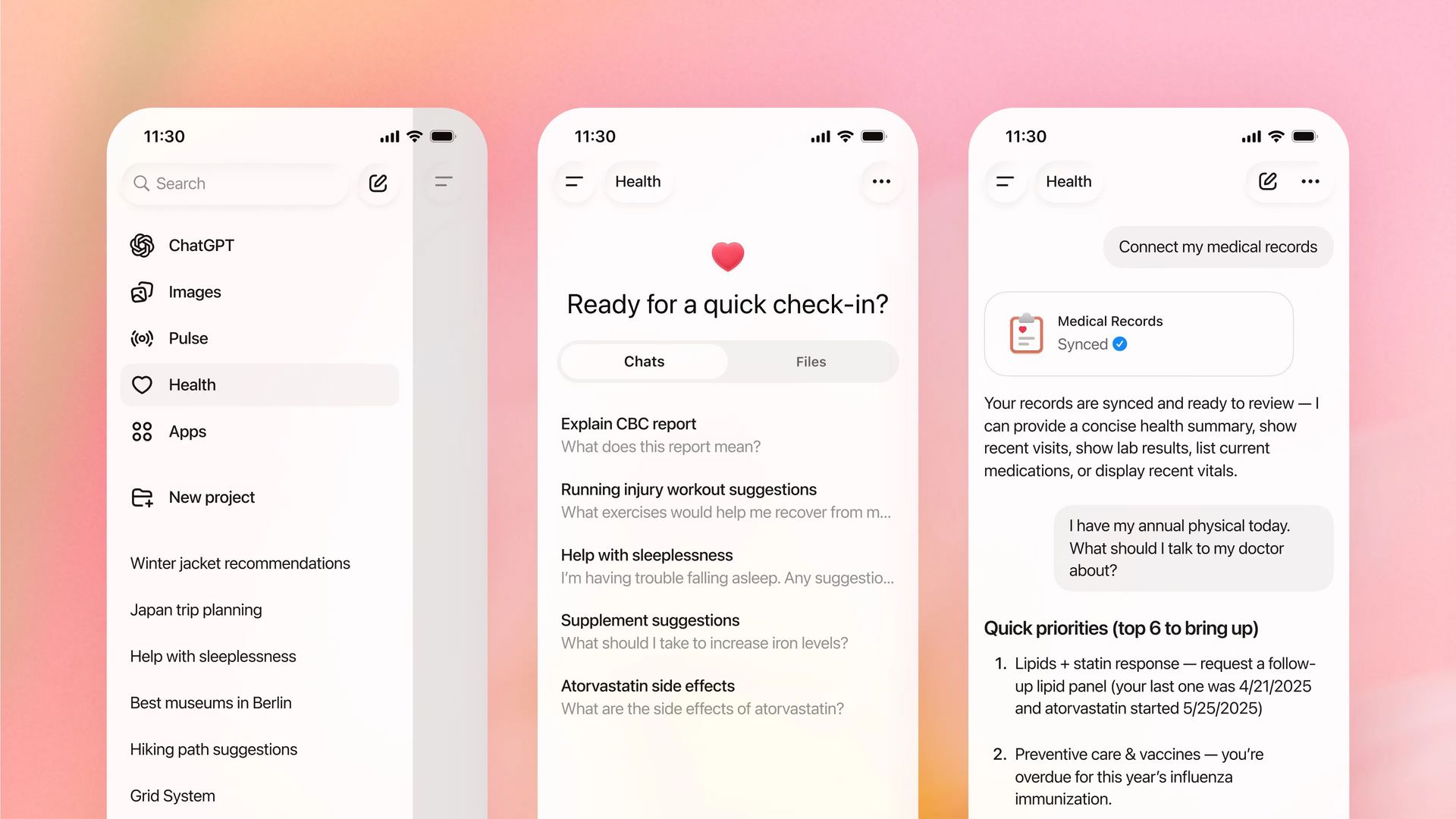
OpenAI wants to be your health care companion. Last week, the high-flying AI startup announced two major initiatives in the health space, one for consumers, and one for large healthcare organizations. ChatGPT Health, which will exist as a second tab on your ChatGPT home screen, will permit consumers to upload any personal health information - including test results and scans from their patient portals, data from their fitness watches, information from wellness apps, and more - into a dedicated, encrypted space. Consumers will then be able to ask questions about their information, get explanations of test results, track trends over time, and get advice about diet and exercise, including help with meal planning and workout routines.
The second initiative, OpenAI for Healthcare, is aimed at large healthcare organizations, and offers them a suite of services that allow the organizations to integrate AI into their daily operations and workflows.
Health is already one of the most frequently asked-about topics on ChatGPT, with 40 million people using it for this purpose each day, and 230 million people each week. Clearly, there is a vast unmet need for hyper-personalized information and advice on health, which includes medical care, diet, and exercise. This, in my personal opinion, as a primary care physician in a large health organization, represents a failure of our current health system. It can take a month or more to see a doctor, or else you have to go to the ER and wait for hours on end. Even then, most doctors are not expert on health issues important to patients such as diet and exercise. There is currently no good way for an individual to get valid, relevant health and wellness information and advice in a timely way that is personalized to them.
AI can help produce the hyper-personalized care at scale that most people want, but the danger is that if it comes from venture-backed startups like OpenAI or public companies like Google, the pressure to make profits for investors can distort the mission to the point that it becomes exploitation rather than help. Witness social media, which we once naively thought would bring us together and open minds, only to see the algorithms reward polarization, division, and disinformation.
Clash of the Titans
Apple caves to Google to save a sinking Siri
After eighteen months of promising to deliver “Apple Intelligence” while Siri stayed dumb as a rock, Apple finally faced reality and inked a multi-year deal with Google to base a newer, smarter Siri on Google’s industry-leading Gemini AI technology. Recent reports of a 33% failure rate on Apple’s internal AI models after months of leadership reshuffling likely wrote the final death warrant for inhouse development. Google models will run on Apple’s Private Cloud Compute servers, so Google will not get direct access to user information, assuring privacy. New Siri is slated to be released this spring, with the upcoming IOS 26.4 update. OpenAI, with whom Apple made a previous deal for AI technology, has now been demoted to a backup plan. Google now gets to gloat over a three-part revenge by 1) ousting a hated rival (OpenAI), 2) making Apple throw in the towel on its in-house AI model-making efforts (See? Toldya AI was hard!), and 3) getting a sweet $1 Billion yearly for its efforts, after years of paying Apple $20 billion annually to make its search engine the default. Happy times in Alphabet City.

Apple hearts Google. OpenAI is sad.
Jensen takes the wheel: Nvidia to give away AI for self-driving cars
Last week, at the mammoth Consumer Electronics Show in Las Vegas, a leather-jacketed Jensen Huang, CEO of premiere AI chipmaker Nvidia, made a bold move to create an open source standard operating system for self-driving cars. Until now, each maker of self-driving vehicles had to develop their own software as well as the hardware. Nvidia wants to relieve carmakers of that burden by giving them free software (and thereby sell them a lot of AI chips.) Nvidia’s new Alpamayo self-driving AI model has a new “reasoning” architecture that goes beyond pattern-matching (the usual strategy) and allows the model to reason about unusual situations, known as “edge cases.” Driving can produce a wide variety of edge cases, and pure pattern-matching is a very inefficient way of learning how to deal with them. Being able to learn concepts and reason through them, like “don’t drive over anything that could die from the experience”, would allow a car to correctly decide to stop for a pigeon in the road but not a tumbleweed.
If carmakers adopt the Alpamayo self-driving AI model, they can go back to competing on familiar issues such as manufacturing and marketing, and quit worrying about competing on the software. Meanwhile Jensen sells them the chips to run it. Happy, foxy Jensen.

Fun News
Microsoft report tracks trends in global AI adoption
Microsoft’s AI Economy Institute has released a report on adoption of AI around the world. The data is derived from Microsoft’s monitoring of PC’s via its Windows operating system, which can track sites visited. A graphic summary of their findings is shown below. In general, developed economies showed higher adoption, but specific government policies can accelerate adoption greatly, such as in the United Arab Emirates and Singapore. The US may be a leader in developing AI, but it is a laggard in usage with just 28% adoption, putting it at 24th place in the world. Among highly-developed countries, only Italy, Finland, and Portugal are lower.
The study found that the open source model DeepSeek from China was a highly popular AI model in China, Russia, Iran, and Cuba (all places where Western technology is unavailable due to sanctions), and in the poorer parts of Africa, where free access to a highly capable model is very attractive. Elsewhere, uptake of DeepSeek has been limited.
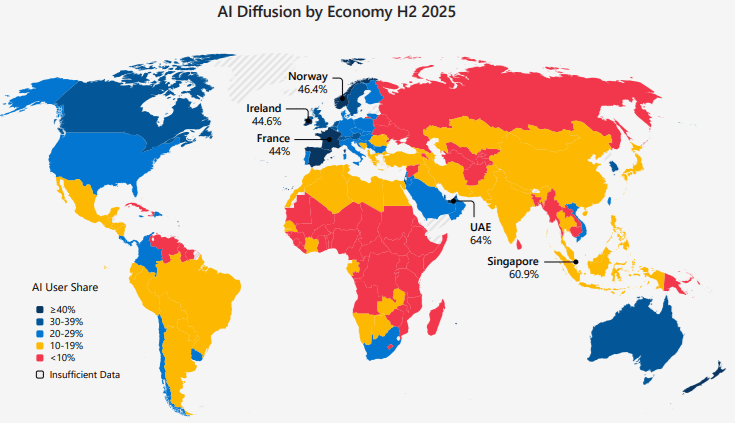
Adoption of AI by the working age population varies from a high of 64% in the UAE to single digits in sub-Saharan Africa. The US is 24th in the world at 28%.
Claude Code and Cowork are changing the nature of work
Anthropic’s Claude AI model is one of the Big Three (along with OpenAI’s ChatGPT and Google’s Gemini), but recently the company’s products have been moving beyond the chatbot to what is being called agentic AI - tools that don’t just talk, but can actually do.
This trend started early last year, with the release of Claude Code, an AI assistant for writing computer code. Over the past year, Claude Code got ever more powerful, and began developing the capability of coding autonomously for relatively long times (minutes to hours), allowing software developers to kick off multiple coding projects in parallel, checking on each project as Claude Code finished each section. This massively increased the productivity of software developers who learned to work this way, and has made Claude Code wildly popular among software developers and the companies that hire them. By November of 2025, just 6 months after general release, Claude Code was generating $1 billion in annualized revenue.
Now Anthropic has generalized the autonomous working aspects of Claude Code, and applied it to nontechnical desktop workflows in a product they are calling Claude Cowork. Claude Cowork allows the user to spin up agents to perform a wide variety of tasks, such as automations of workflows by connecting different apps like Notion, Gmail, Slack, and more. Cowork is currently in limited release to a waiting list of Claude Max paid users ($100 - $200 per month), but is expected to roll out more widely over the rest of this year.
Early reviews indicate that Claude Cowork may inaugurate a new paradigm for working with AI, where it becomes more like an assistant that you manage than a tool that you use.

Google’s Universal Commerce Protocol will help your AI agents shop
If Cowork can give you agents (see story above), Google wants to make sure that those agents can shop for you. The company has released UCP, for Universal Commerce Protocol, as a universal language that allows AI agents to securely interact with vendors in order to handle shopping end-to-end. Developed in alliance with major vendors such as Shopify, Walmart, and Target, UCP can enable autonomous AI agents to perform product search, comparisons, and even buying items with a secure digital wallet. This capability will be on display shortly in Google’s AI Mode in Search, and in the Gemini app, where you will be able to checkout directly using Google Pay after having found an item with AI, without leaving the chat.

Robots
Google’s Wing drone division will open in 150 more Walmarts
The Google-backed Wing drone delivery service, launched in 2023, has been focused on hyperlocal on-demand delivery of small items to Walmart customers in Dallas-Fort Worth and Atlanta. The service has gone so well, that the 2 companies are expanding it to 150 additional Walmart stores in large cities across the country, at which point it will be available to approximately 10% of the US population. The company states that the most commonly ordered items are eggs, ground beef, fruit and produce, lunchables, and snacks.

Wing’s drones bring snacks and produce on demand to Walmart customers.
Roborock launches its first robot lawnmower in the US
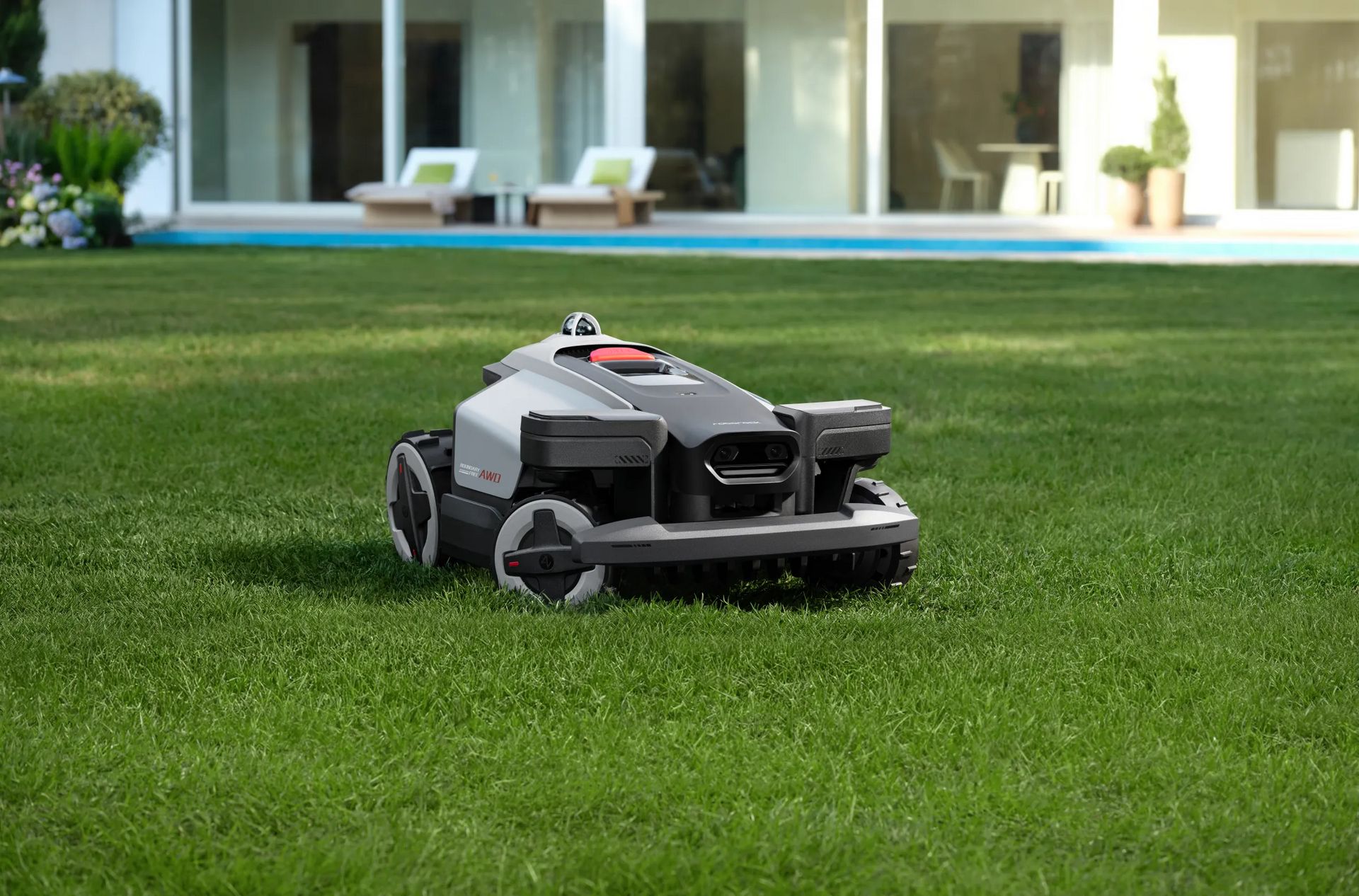
Chinese robotic vacuum cleaner manufacturer Roborock moved into robot lawnmowers last year, initially in Europe. Now it is launching in the US later this year. The company’s robot lawnmowers navigate with AI, using LIDAR as well as cameras. They are ruggedly built with high capacity batteries, an electric motor for each wheel, and a dynamic suspension that allows them to climb a slope with an 80% grade. The expected prices for the various models range from $900 to $2500, surprisingly affordable compared to most other robot mowers and to riding mowers.
AI in Medicine
AI is now licensed to prescribe medications in Utah
The state of Utah has licensed an autonomous AI system to renew prescriptions of around 190 low-risk medications for common diseases such as diabetes and high blood pressure. Utah’s Office of Artificial Intelligence Policy has entered into a groundbreaking contract with Doctronic, a New York-based health AI startup founded in 2023. The contract requires Doctronic to carry medical liability insurance for its autonomously prescribing AI. This pilot operates under what Utah state government is calling a “regulatory sandbox”, in which innovative AI programs found to be in the public interest are given some regulatory leeway to prove their worth. If this experiment is successful, we can expect more AI automation of low-risk physician tasks.

Health AI startup Doctronic is now licensed to prescribe in Utah.
Sleep study AI can predict 130 diseases
Stanford researchers have developed an AI model that can predict 130 different diseases, sometimes years in advance, from one night of sleep. The model was trained on a dataset of over 585,00 hours of sensor recordings from approximately 65,000 patients being studied in a sleep lab for possible sleep apnea or other sleep disturbances. From one night of sleep, the data accurately predicts 130 conditions, with p-value of less than 0.01. Conditions predicted include all-cause mortality, dementia, myocardial infarction, heart failure, chronic kidney disease, stroke, and atrial fibrillation. Sleep labs have fallen into disfavor with health plans in recent years, and they typically require a simplified home sleep test before considering coverage of a lab sleep test. AI models like this one may show that there is more value in the voluminous physiologic data collected in a sleep lab than we were aware of.
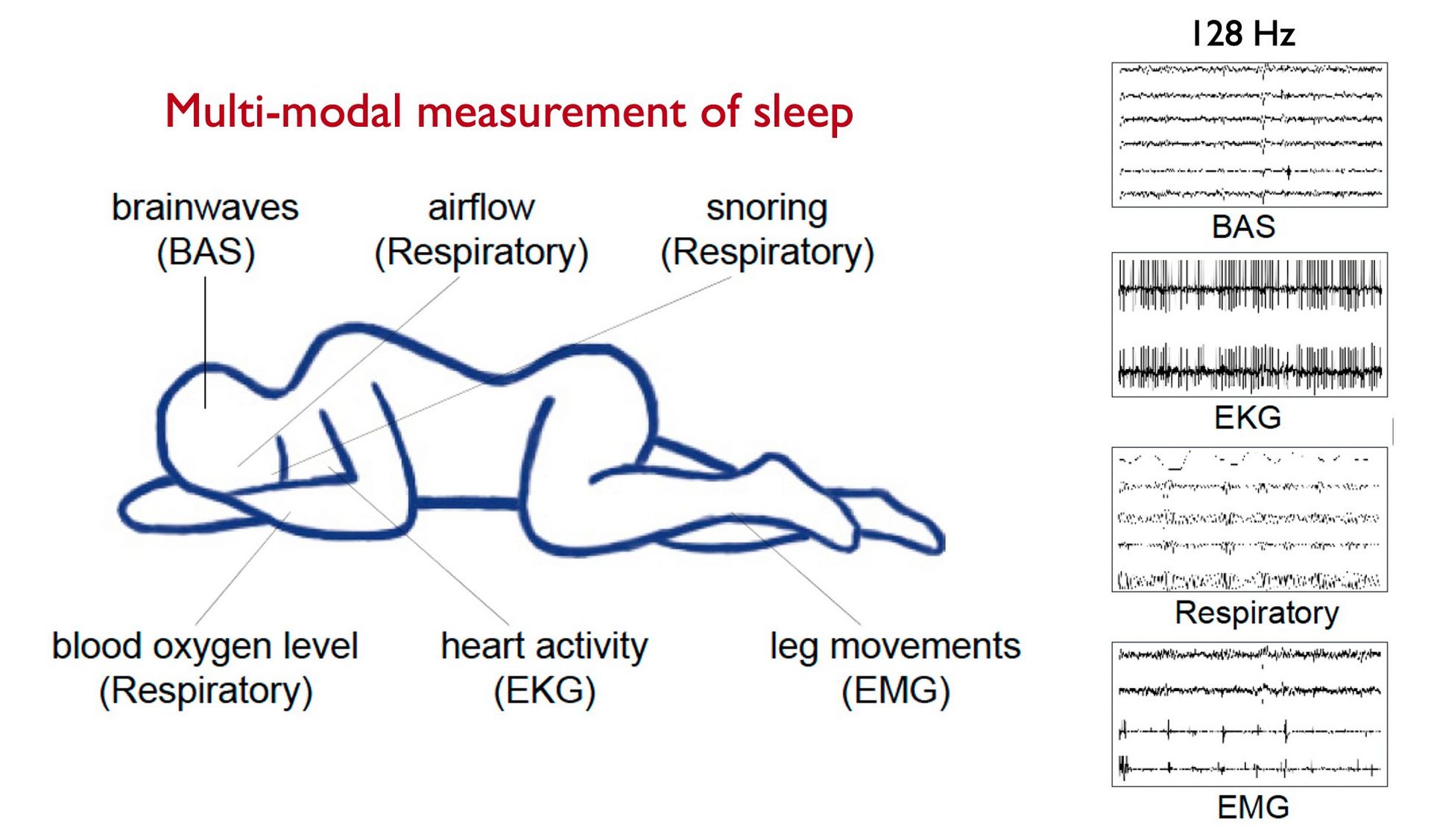
Sleep labs collect copious physiologic information during a sleep study. Now AI can use that data to accurately predict 130 different diseases, sometimes years in advance.
That's a wrap! More news next week.