- AI Weekly Wrap-Up
- Posts
- New Post 1-21-2025
New Post 1-21-2025

Keith Collins MD
January 21, 2026
Top Story
Study shows AI replacing tasks, not jobs
AI startup Anthropic has released the latest version of its Economic Index report, which periodically studies how users use its Claude chatbot, in order to assess the potential impact of AI on jobs and the economy. Current trends show that for now, AI is replacing tasks, not jobs. This means that jobs are changing. For some jobs, like travel agents and technical writers, AI takes over the complex planning and analysis, leaving the human with more mundane administrative tasks. This is called “de-skilling.” For other jobs, like property management, AI takes over the bookkeeping, allowing the human to focus on high-value tasks like contract negotiations. This is an example of the reverse process, or “upskilling.” Which process dominates will have major impacts on specific jobs, industries, and the economy as a whole.
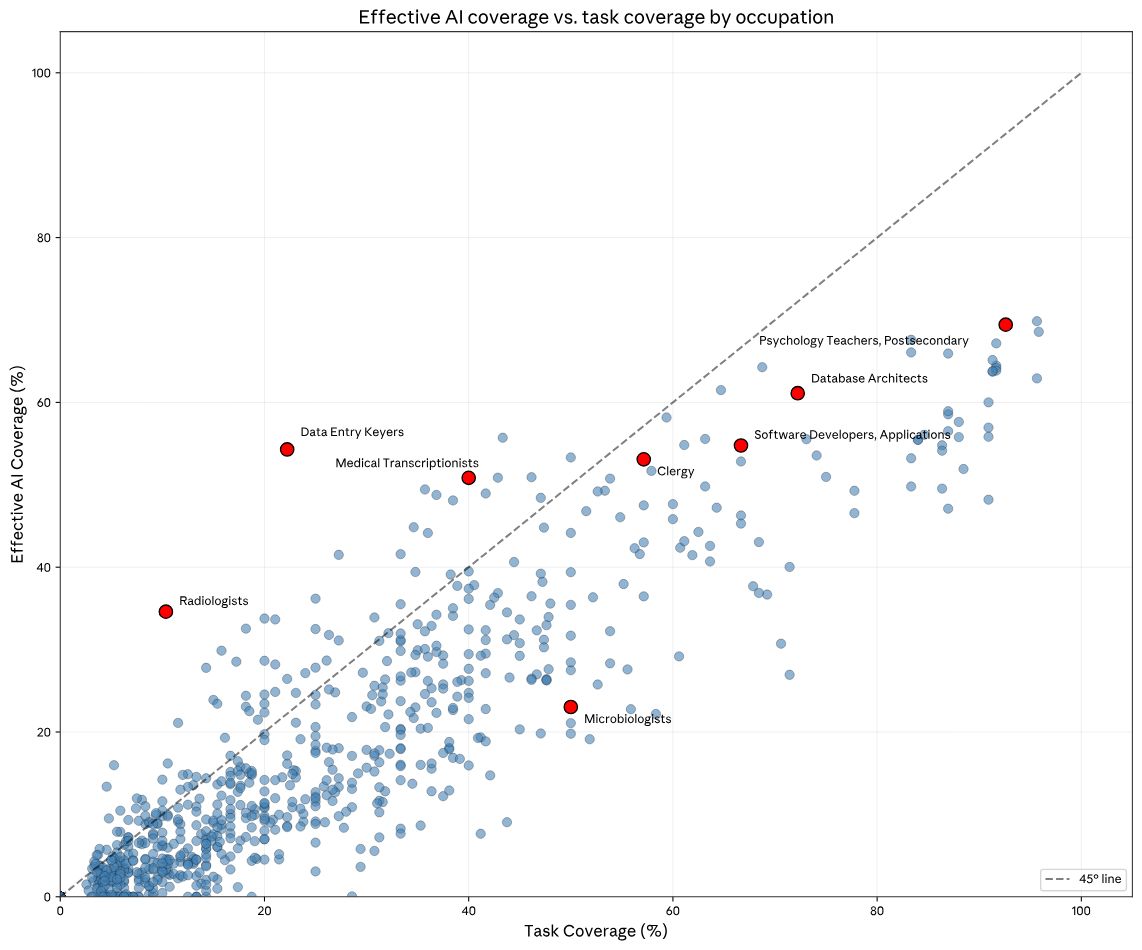
Task coverage (X axis) measures what % of a job’s tasks can be performed by AI. Effective AI Coverage (Y axis) how much of a typical workday AI could replace for a given job. Either way, Psychology professors are toast.
Clash of the Titans
OpenAI to begin testing ads - and age prediction
OpenAI CEO Sam Altman’s vaulting ambition has led him to make growth commitments for the company that are projected to burn $115 billion (with a B!) before breakeven. Q: How is OpenAI going to fill that gaping revenue hole? A: Any way they can. This means no more “free lunch” for the Free and Go ($8/month in developing countries) tiers. These users will begin to see “Sponsored” content which is relevant to their chats with the chatbot. In other words: targeted ads. Sam pinky-swears that the ads will not influence the answers the chatbot gives (except, maybe, if he really, really needs to…).
In related news, OpenAI is testing age prediction algorithms, which can estimate a user’s age from various pieces of information the user has revealed. Why is predicting a user’s age so important? Because multiple countries have made it illegal to show certain kinds of content to children and teens. And Sam is looking to add “adult content” as another revenue enhancer. Ads. Porn. Ads for porn. Porn in ads. The possibilities are endless…
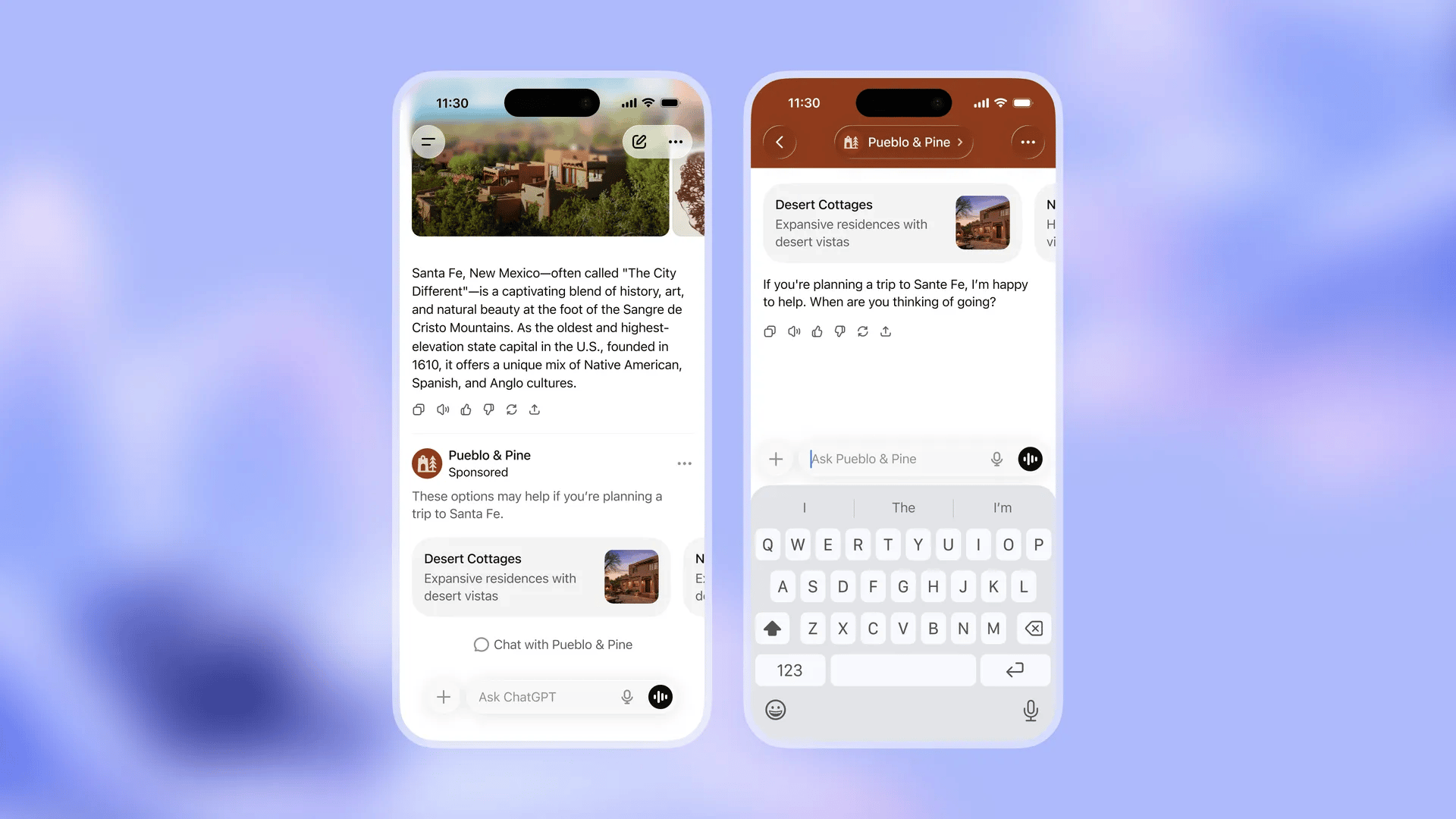
ChatGPT will be showing “Sponsored content” - ads - to Free users, as shown above. We leave the adult content to your imagination.
Wikipedia announces content deals with multiple AI companies
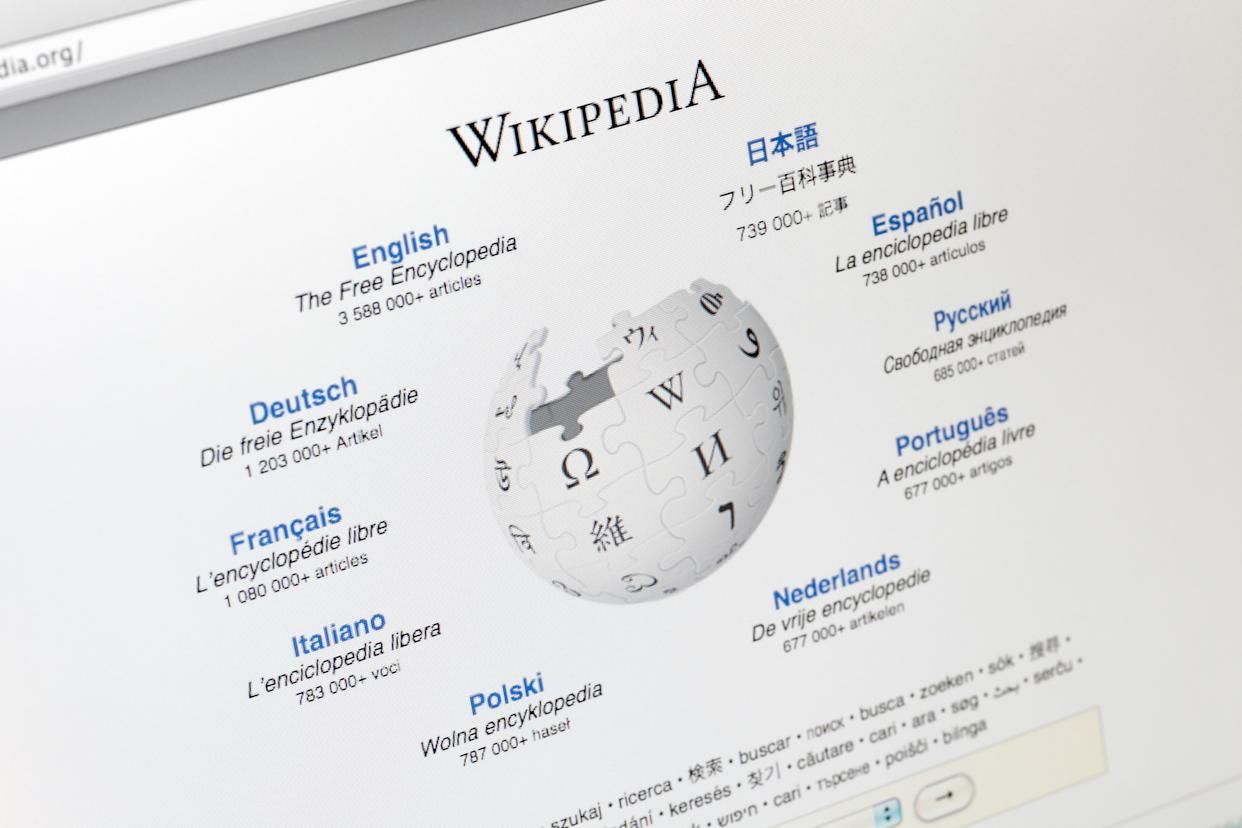
Wikipedia, beloved not-for-profit relic of the internet’s early, idealistic phase, when we naively thought that access to all the world’s knowledge would make people smarter, is celebrating its 25th birthday by stepping into the AI era. Like all media organizations, Wikipedia web traffic has been cannibalized by AI bots that scrape their content for free and then present an “AI overview” of the information requested by a user, rather than directing that user to the source. Facing this potentially existential threat to its survival, Wikipedia has convinced many AI companies, including Meta/Facebook, Microsoft, Mistral, and Perplexity to pay for access to its high-quality, 100% human-generated content. Such content is particularly valuable for AI model training and quality control, and helps avoid what is called “model collapse”, in which AI slop becomes so pervasive that it infects the training of models and makes them progressively worse rather than better with more data or more training. For now, Wikipedia can continue to keep the hope alive that artificial intelligence can help humans combat their natural stupidity.
Fun News
The percent of businesses paying subscriptions for AI doubled in 2025
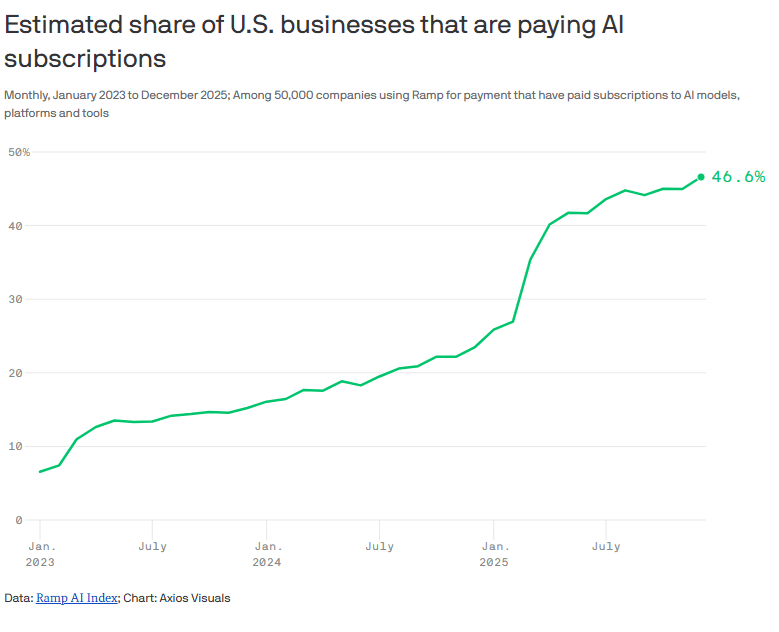
A new study from Ramp indicates that the percentage of US businesses paying for one or more AI tools roughly doubled in 2025, from 23.4% in December of 2024 to 46.6% in December of 2025. Besides the 100% year-over-year growth, the proportion of businesses paying for AI has reached a tipping point, where very soon, there will be more businesses paying for AI tools than businesses that don’t. AI will have become the default business tool in a little more than 3 years, an almost unprecedented rate of adoption.
Claude Code has a “ChatGPT moment”, software stocks falter
Last week we reported on the rapidly increasing popularity of Anthropic’s AI software assistant, Claude Code, which achieved $1 billion in annualized revenue in just 6 months. Claude Code is widely praised for making professional software developers much more productive, and for enabling noncoders to create apps just by talking to the AI.
The glee at Anthropic headquarters is matched by the despair of traditional software companies, who may see their entire business model evaporate when businesses, and even individual users, can quickly get a working application custom-tailored to their needs within minutes or hours just by talking to an AI.
Wall Street is taking notice. Stocks of SaaS (Software-as-a-Service) vendors have slumped in recent months, with market leader Salesforce down 38% over the past year, from a peak of $360 on 1/28/25, down to $222 on the most recent day of trading. A full 12% of the 38% decline has occurred over the first 3 weeks of 2026. Yikes.
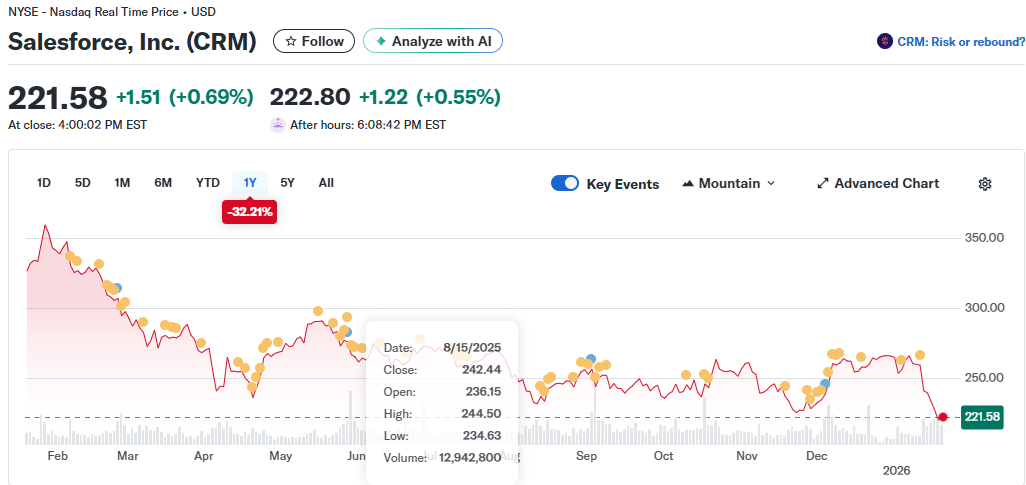
Salesforce, once a market darling, has slumped nearly 40% over the past year. Claude Code is a part of that fall from favor.
AI in Medicine
Mass General offers AI-assisted virtual PCP program
In response to the dire shortage of primary care physicians in the Boston area, this past September Mass General Brigham launched Care Connect, its AI-assisted virtual PCP program. MGB contracts with K Health, a New York-based company founded in 2016, that offers an AI triage agent that gathers information about the patient’s reasons for seeking a visit, symptoms, medications, etc., then sends a summary of the interaction and a suggested treatment plan to a remote physician who then reviews, edits, and ultimately approves a plan. If either the doctor or the patient want direct physician interaction, there is a team of telehealth physicians that are available on short notice. The early months of the program have shown both that the need is there for such a service, and that a substantial number of patients will accept it. Expect such initiatives to proliferate.
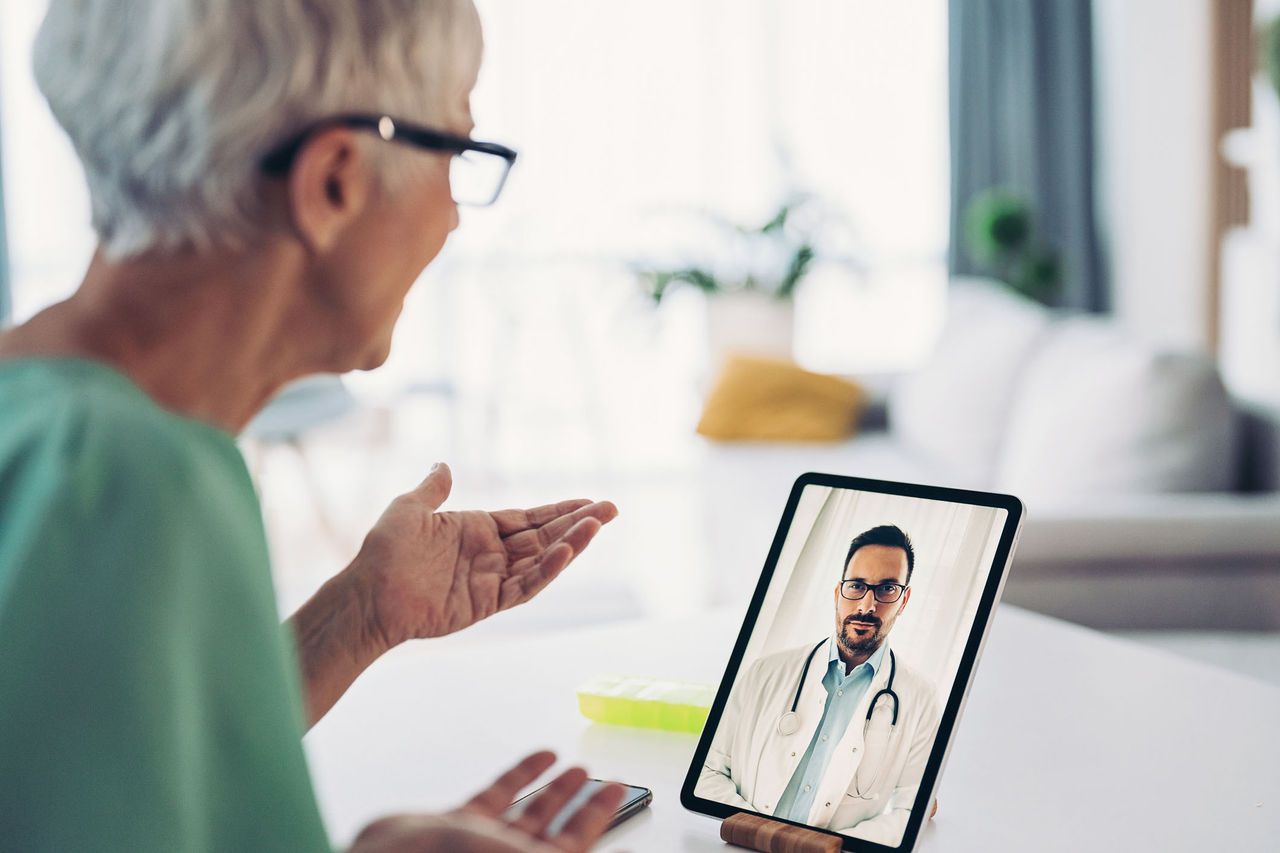
AI-assisted triage and telehealth visits help ease Boston PCP shortage.
Report: AI in medicine works best as a teammate, not a replacement
ARISE, a Stanford-Harvard AI research collaborative, just released their 2026 State of Clinical AI report, and it is full of hard-won insights as to what actually works for AI in medicine. There are 6 major findings, but the central one is this: AI is highly capable, but is brittle in real world settings, often getting confused or going off track. Therefore, at the current state of maturity, clinician + AI teams reliably outperform either one alone when integration is done well. This conclusion holds across domains including imaging, diagnostics, and treatment planning. One can hope that health plans and health systems will take heed.

That's a wrap! More news next week.