- AI Weekly Wrap-Up
- Posts
- New Post 12-17-2025
New Post 12-17-2025

Keith Collins MD
December 17, 2025
Top Story
The Empire Strikes Back: OpenAI releases ChatGPT 5.2 to parry Google’s Gemini 3
When Google released its newest Gemini 3 AI model last month, to rave reviews, OpenAI went into “code red” panic mode to equal or beat the new performance leader. Now, less than a month later, we have OpenAI’s response - its newest model, GPT 5.2, is a banger. It edges out Gemini 3 on most benchmarks, and blows it away in a couple of high-profile uses.
GPT 5.2 has greatly increased its performance on a wide variety of economically valuable tasks, as measured by its scores on the GDPval benchmark (see graph below.) This test pits work output from the AI model against output from human experts in a given field, and then has other experts pick the better product without knowing the source, human or AI. GPT 5.2 appears to have moved into a commanding lead on this measure, winning 60% of comparisons outright, and tied for an additional 14% of contests, leaving humans as the winner in only 25% of comparisons.
OpenAI’s new model also took the lead in the ARC-AGI test, specifically designed to be hard for AI but easier for humans. Strikingly, GPT 5.2 was so much more efficient at solving these tests that the cost of computing each task fell from over $4000 per task, to approximately $11 per task.
Could it be that future AI might not need all those energy-hogging data centers after all? That could be the trillion-dollar question.

GPT-5.2 equals or exceeds human experts on a variety of business tasks.
Clash of the Titans
Microsoft releases data on how people use its Copilot AI
Microsoft has released an analysis of 37.5 million conversations with its AI model, Copilot, which is included in subscriptions to Microsoft Office products such as Word and Excel. Some major findings:
On the mobile app, health is the dominant topic - all day, every day. Users utilized Copilot not just for information, but for advice.
On the desktop, technology and business uses dominate during the day, while after hours and on weekends users ask about gaming, philosophical questions, and relationship issues.
Over all, it appears that users are integrating AI into a broad spectrum of their work and personal lives,

People use Microsoft’s Copilot phone app most for health information and advice.
Nvidia challenges Chinese open source AI models with Nemotron Nano
Over the past year, Chinese companies have surged into the lead on open source AI models (models that are free to use on your own computer), with performance that is very near that of the Western proprietary closed source models from the likes of Google, Anthropic, and OpenAI.
Whether the future is dominated by open source models or closed source models is a question with vast implications for the future of the technology, and for society.
Now leading AI chipmaker Nvidia has entered the fray, with vast technical and financial resources. The company has released a highly innovative and efficient open source model, called Nemotron Nano. Although comparatively tiny for an AI model, with only 30 billion parameters (ChatGPT reportedly has over a trillion), Nvidia’s model is surprisingly powerful. In addition, it is highly efficient in its computing due to an innovative hybrid architecture.
As AI matures, Nvidia is betting that compactness and efficiency will matter more and more, and the sprawling, energy-hogging models of today will be supplanted by smaller, sleeker, more efficient designs in the future.

Nvidia CEO Jensen Huang announces a new family of innovative open source models.
Fun News
Purdue University announces AI requirement for all undergrads
Purdue University just announced that all undergraduates will be required to demonstrate competency in AI as a requirement for graduation, beginning with incoming freshman classes entering this fall. 2026. The requirement will be embedded into existing courses, rather than being a separate credit-hour requirement. Purdue will be expanding its current partnership with Google in order to make AI tools available to all students.

Purdue mandates AI competency requirement for all new undergraduates, starting this fall.
Disney inks deal with OpenAI to license characters, buy stock
Disney has signed a landmark, multi-faceted deal with OpenAI. Under the terms of the agreement, Disney will invest $1 billion into OpenAI in return for equity in the high-flying startup, and the opportunity to obtain more equity in the future. In addition, Disney is licensing some 200 characters on which it holds copyright for use in Sora, OpenAI’s short-form video social media offering. Notably, only a character’s image, and not its voice, is licensed - so no talking, no long videos. Disney will continue to exert considerable control over how its characters are used in the app, and OpenAI is promising to develop guardrails in Sora to prevent objectionable use. Finally, Disney will have the right to air curated user-generated videos on its Disney+ streaming service.

Anna and Elsa are frozen in shock at the $1 billion Disney deal with OpenAI.
Robots
Chinese home appliance firm announces 6-armed wheeled robot
Midea, a giant Chinese home appliance manufacturer, is now a major developer of robots for the home and the factory. In 2016, facing rising competition in the home appliance sector, the company pivoted hard into robotics by buying Kuka, a legendary German industrial robotics firm.
While humanoid robots with 2 arms and 2 legs grab all the headlines, Midea takes a a contrarian path. The company’s industrial humanoid robots have wheeled bases for stability, and multiple arms, so that the robot can multitask for complex assembly tasks on the factory production line.
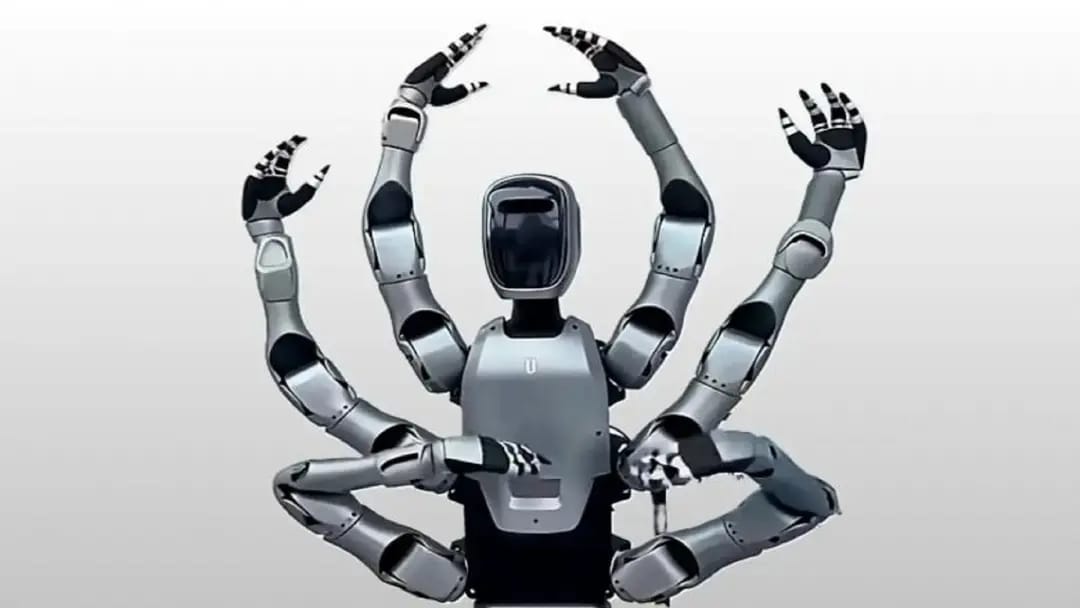
Looking like a Hindu deity, Midea’s factory robot is built for utility, not arbitrary humanoid esthetics.
UPenn develops microscopic programmable robots
A multi-institutional team led by researchers at the University of Pennsylvania are developing robots the size of a single-celled organism which are capable of fully autonomous operation. Until now, all robots below a millimeter in size needed to be controlled externally, greatly reducing their ability to react quickly to their local environment. The UPenn team have used the same techniques of silicon lithography that make advanced computer chips, to create a microbot that can sense, compute, and react entirely with onboard electronics. This opens up a wide range of applications, including medical uses with microscopic robots swimming in a patient’s bloodstream to deliver medication to the precise site where it is needed.

UPenn’s microbot swimming over a submerged penny.
AI in Medicine
AI creates personalized cancer treatment roadmap from slides
Microsoft-supported researchers at the University of Washington in Seattle have developed an AI model that allows tailoring of cancer treatments to an individual’s personal biology as well as the biology of the patient’s specific tumor. This circumvents one of the critical weaknesses of nearly all medical science - current treatments are based on average results for a group of patients, rather than on a deep understanding of how the individual patient will respond. The goal of precision medicine is to bridge this gap. The UW researchers trained an AI system to analyze standard microscopic pathology slides to identify whether the patient’s immune system is fighting the cancer, and what the tumor’s response is. The result is a much clearer roadmap of how to best treat this particular tumor in this particular patient.

AI system takes images of pathology slides (left) and makes a detailed analysis of the patient’s immune response to the cancer, allowing individualized treatment.
Medra raises $52 million for a robot scientist
AI startup Medra has just raised $52 million for development of a robotic scientist for new drug discovery. The robotic system will run experiments semi-autonomously, guided by natural-language instructions from human scientists. The goal is to speed up drug discovery by running far more experiments than are possible for human researchers, then iterate on experimental results faster, in order to home in on promising drug candidates more quickly.

Medra CEO & Founder Michelle Lee, PhD, with her company’s robot scientist.
That's a wrap! More news next year! AI Weekly Wrap-up will go on holiday until January 7, 2026.