- AI Weekly Wrap-Up
- Posts
- New post 3-25-2026
New post 3-25-2026

Keith Collins MD
March 25, 2026
Top Story
Anthropic polls 81,000 users on attitudes on AI
AI model-maker Anthropic just released the results of a poll of 81,000 of their users, who were asked how they used AI and what they felt about it. The major findings:
The most common business use of AI was to automate mundane tasks. For some, this was to allow more focus on strategic initiatives. For others, it was to spend less time at work and have more time with family and friends.
Learning vs. Cognitive Decay. For 33% of users, AI was a useful learning tool. However, large numbers of students and even larger numbers of teachers report seeing evidence of cognitive atrophy - losing the ability to perform the work without relying on AI.
AI as a “Capital Bypass” mechanism. In emerging economies around the world, AI is being used to allow entrepreneurs to start businesses, or students to learn skills, without the high costs associated with these activities in Western societies.
Scaffolding for Executive Function. Some 14% of respondents s primarily use AI for life management - for planning, memory, and task follow-through.
Self-employed workers see much more economic value in AI than employees of larger companies. 47% of small business owners have seen real economic return from AI, whereas only 14% of large company employees have seen this. An interesting nuance here is that freelancers see great value in the tools that may end up replacing them
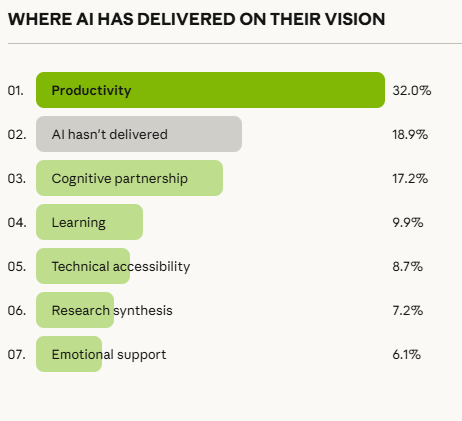
Top areas where users say AI has been useful.
Clash of the Titans
Jensen Huang says Agents are having a “ChatGPT moment”
Nvidia CEO Jensen Huang has declared 2026 the Year of the AI Agent. Growing beyond the traditional chatbot function, AI agents actually perform real-world tasks for you. The dawn of this new era was heralded in January by the viral success of what is now called OpenClaw, an AI personal assistant hacked together over a weekend by a burned-out software engineer just looking to automate some of the tedious tasks of his life. Now users of OpenClaw number in the millions, and all the top AI model-makers are racing to add agentic features to their chatbots. Jensen’s own company has come out with NemoClaw, a security wrapper for the notoriously wide-open OpenClaw, reducing OpenClaw’s vulnerability to malicious attacks, and putting guardrails on its behavior so that it is less likely to delete all your emails or perform other destructive acts.
The mania for OpenClaw has revealed a vast market for an AI-powered personal assistant, and all the top AI companies are moving full speed ahead to develop a winning product in this category.

An AI-generated cartoon of Nvidia CEO Jensen Huang touting his company’s “NemoClaw” AI Agent.
Teens file lawsuit against Elon’s Grok AI for nonconsensual sex images
Elon took over Twitter and renamed it X, claiming that he would make it a bastion of free speech. To date, this has meant X has served as an unfiltered platform for right wing disinformation and conspiracy theories, and a place where users can use Elon’s Grok AI model to make sexy AI-generated pictures. Now three teenage girls in Tennessee have sued Grok AI for allegedly generating sexually explicit deepfake images of them without their consent. Two of the teens are under the age of 18, so that these allegations, if proved, constitute the felony of trafficking of child pornography. This is in addition to any invasion of privacy, defamation, and mental and emotional distress damages that may be assessed.

Elon Musk touted Grok AI’s “spicy” mode; now he’s being sued for sexy deepfakes of underage girls.
Fun News
Think tank estimates which jobs are most vulnerable to AI
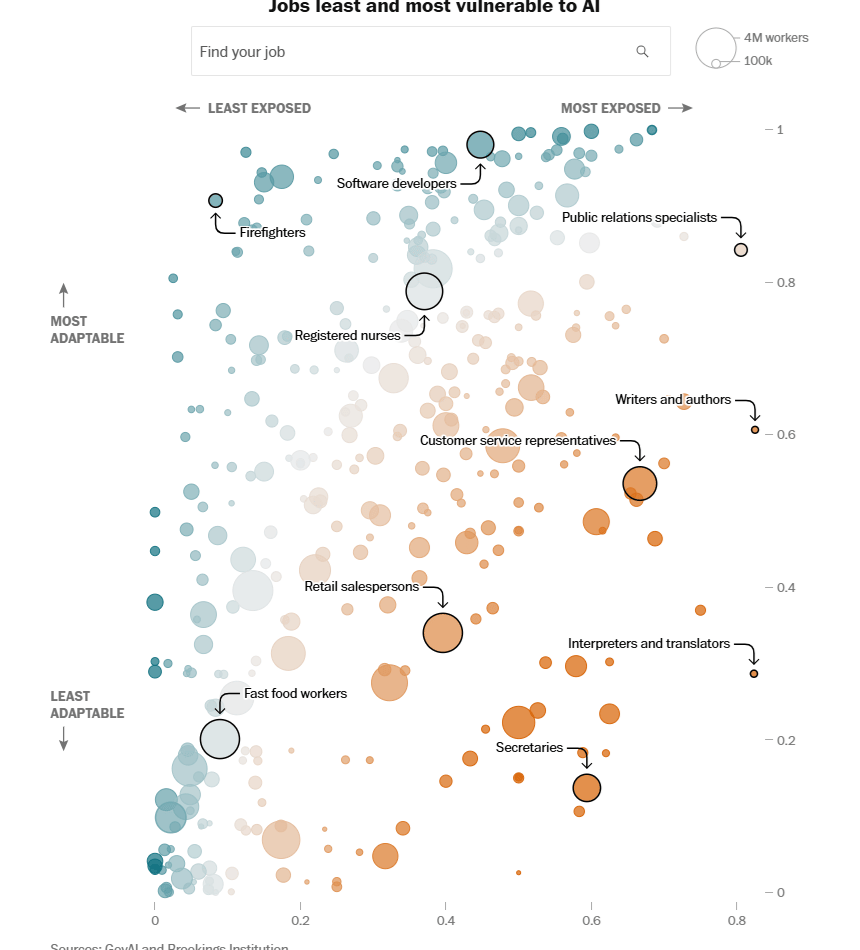
The folks at GovAI, a policy analysis organization, have estimated the exposure of over 350 job categories to automation by AI. They also estimated the potential adaptability of the holders of each job - the likelihood of displaced workers in that job finding comparable employment in another field. The result is the scatter-plot below, where the horizontal axis measures exposure to displacement by AI, and the vertical axis measures the estimated adaptability of workers in that job.
Some of the sectors that are most exposed, like software engineering, also contain highly-educated professionals who are likely to find employment elsewhere. On the other hand, job categories like secretaries have both high potential for automation, and low adaptability of their skills to other job categories. Follow the link to query the interactive job map to see where your job ranks.
Google releases Groundsource database of urban flash floods
Google has released Groundsource, a methodology for creating structured databases from unstructured news reports. An AI application scans a compendium of news reports from around the country or around the globe, and extracts the data points to put in the database, which can then be analyzed much more quickly and easily with conventional data analysis tools. As a first example, Google created a database of urban flash floods in the US. Data on flooding in cities is notoriously sparse, because it is highly localized, sometimes covering just a few streets. The best source of information on these floods is often the local news reports. By scanning millions of these local news reports, Google has created a searchable database of urban floods around the world, allowing for analysis of common factors and trends.
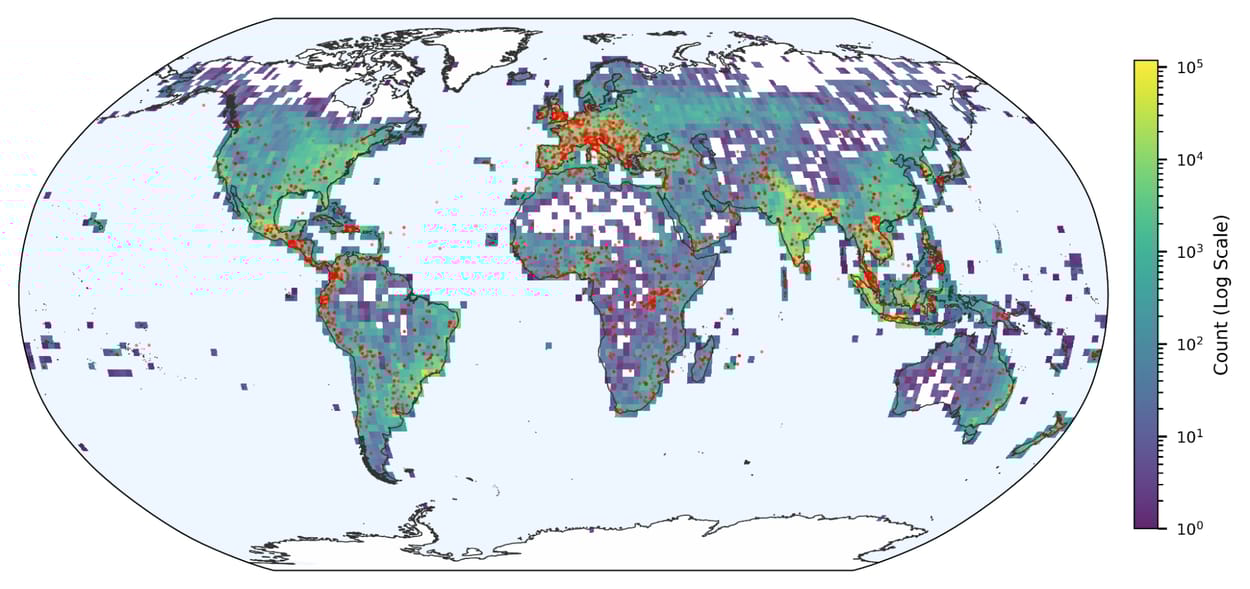
A global map showing the density of flood events in Google’s Groundsource.
Robots
$300,000 robot dogs are guarding massive data centers
Big Tech is investing hundreds of billions of dollars building an ever expanding number of huge data centers to fuel the expected AI revolution. These data centers need to be highly secure, so security costs are substantial. One of the newest trends in data center security is the deployment of semi-autonomous robot guard dogs, who patrol the perimeter 24/7, loaded with sensors and two-way communication with a central monitoring station. Each robot guard dog can cost $150,000 - $300,000, depending on the capabilities of each model. Even at that price, data center operators are calculating payback in 2 years with decreased costs for round-the-clock human security personnel.
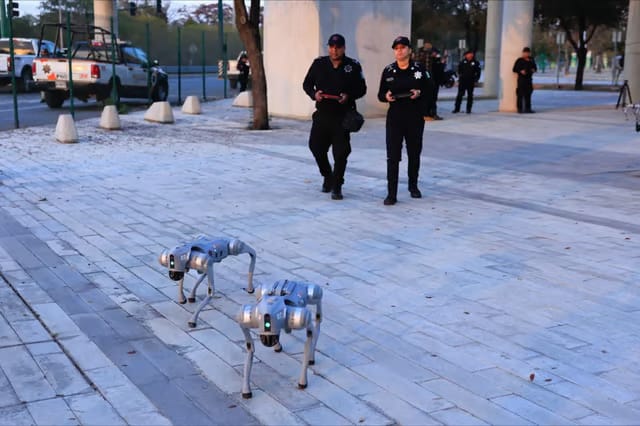
Robot dogs like these are increasingly being used as security for data centers.
The US Navy has awarded a $71 million contract to Gecko Robotics for a pilot program to speed up inspections of warships while in drydock, which should ultimately decrease idle time for the fleet, and increase the percentage of warships deemed ready for use. A major goal for today’s Navy is to increase the readiness percentage from its current 70% or below, to at least 80%. Robots and drones are projected to be able to complete the needed inspections in days instead of the weeks required by human inspectors, drastically decreasing downtime of the affected vessels, and thus boosting the readiness quotient.
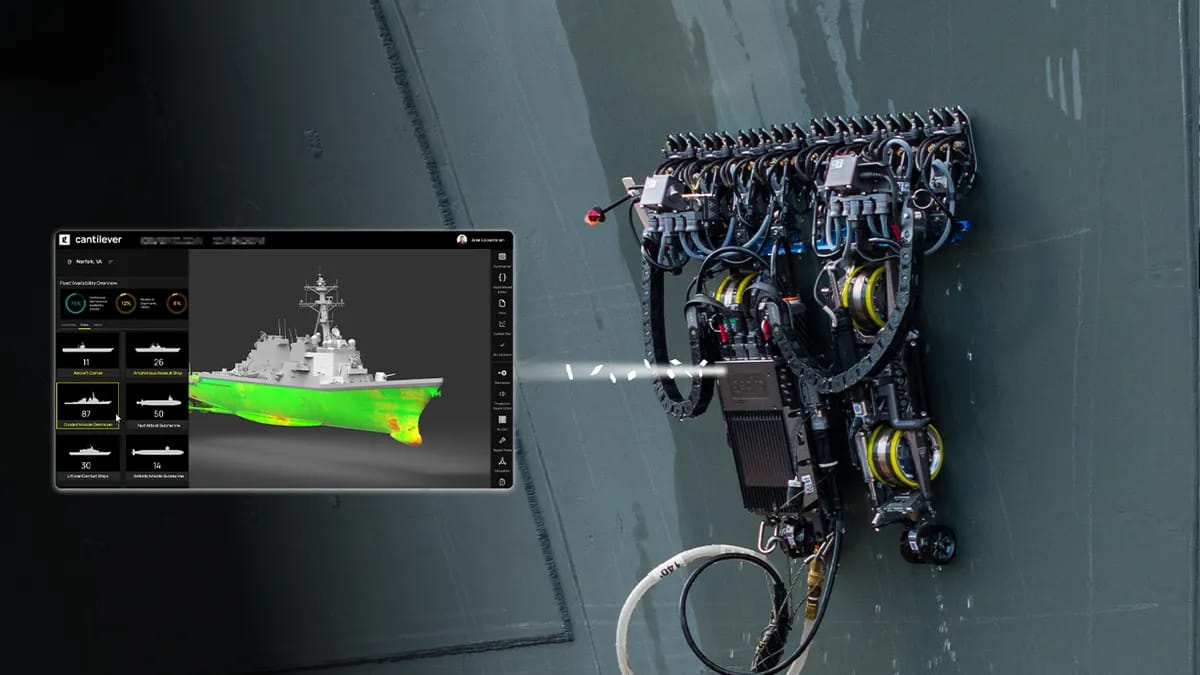
Gecko robot (right) crawls the hull of a warship, sending data on defects to a central database (left).
AI in Medicine
AI-designed molecule boosts chemotherapy response in pancreatic cancer
Researchers at the Italian Institute of Technology have used AI to design a “booster” molecule that makes pancreatic cancer cells more sensitive to chemotherapy. Pancreatic cancer is notoriously hard to treat, and mean survival times after diagnosis are distressingly low. The AI-designed booster molecule increases pancreatic cancer cell sensitivity to standard chemotherapy. The hope is that this will enhance the effectiveness of the chemotherapy, while allowing the use of lower doses, which should decrease the incidence of noxious side effects.
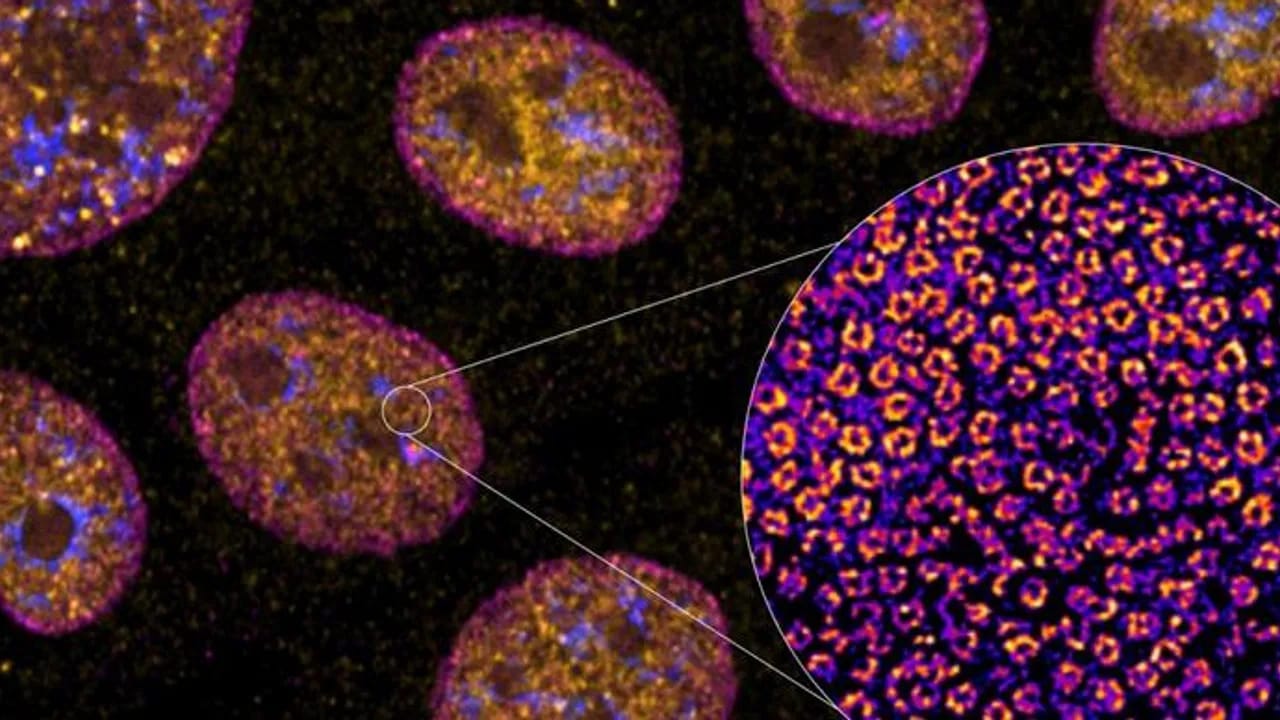
An AI-designed molecule disables a protein in pancreatic cancer cells, boosting response to standard chemotherapy.
Autonomous dental robot replaces crown in 15 minutes
A dental robot built by US company Perceptive autonomously drills and shapes a patient’s tooth to accept a crown in 15 minutes. The dentist first scans the tooth with a handheld ultrasound, and the robot develops a plan for shaping the tooth and the crown. Once the dentist approves the plan, a milling machine attached to the robot begins shaping the crown to mesh with the surrounding teeth and to fit onto the tooth shaped by the robot. The robot shapes the tooth to accept the crown, with the dentist supervising, keeping a foot on a pedal that can instantly halt the robot if anything goes amiss. Once the crown and the tooth have been shaped, the dentist places the crown, making any final micro-adjustment to assure good fit and function. The whole process takes about 15 minutes in a single patient visit, as opposed to 2-plus hours spread over visits 2 weeks apart as in the standard process.
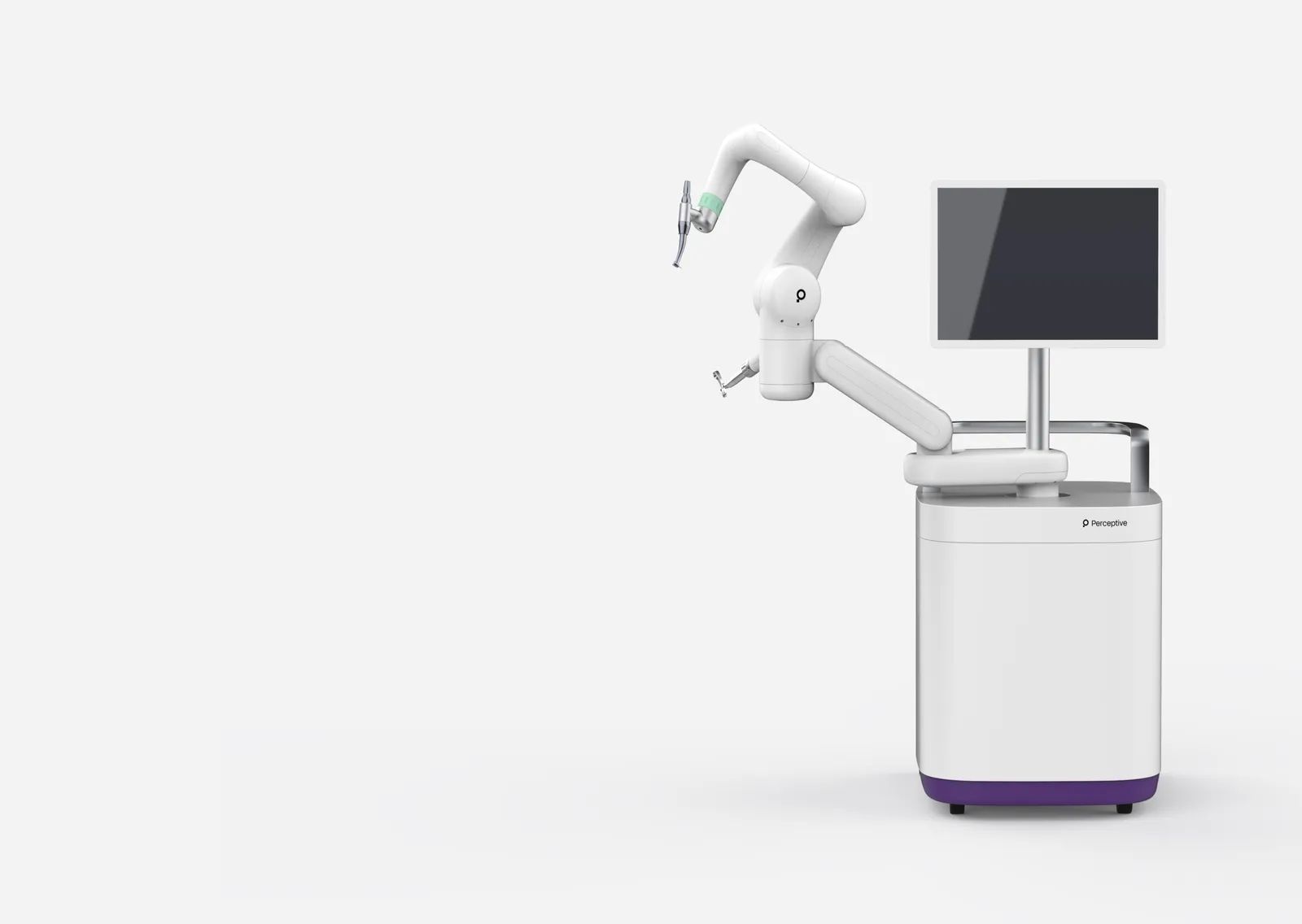
Perceptive’s autonomous dental robot
That's a wrap! More news next week.